

International Economics
- 이화여자대학교
- 오진환

 페이스북
페이스북 트위터
트위터 카카오톡
카카오톡 네이버밴드
네이버밴드 링크복사
링크복사


-
- 주제분류
- 사회과학 >경영ㆍ경제 >경제학
-
- 강의학기
- 2018년 1학기
-
- 조회수
- 11,236
-
- 강의계획서
- 강의계획서
<교재 및 출처>
- Feenstra, Robert and Alan Taylor. International Economics (2nd edition)
- Chang, Ha-joon (2008). Bad Samaritans: The Myth of Free Trade and the Secret History of Capitalism.
- Feenstra, Robert and Alan Taylor. International Economics (2nd edition)
- Chang, Ha-joon (2008). Bad Samaritans: The Myth of Free Trade and the Secret History of Capitalism.
차시별 강의


| 1. | |
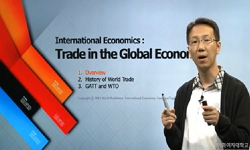
Trade in the Global Economy I | Structures and plans of this lectures are provided |  |
|
Trade in the Global Economy II | Overviews history of international trade | |
|
|
Trade in the Global Economy III | Discusses important articles and major activities of GATT and WTO | |
|
| 2. | |
Ricardian Model I | Basic concepts of the model - opportunity cost and comparative advantage, in particular- are explained | |
|
Ricardian Model II | Overviews main concept of production possiblity frontier. | |
|
|
Ricardian Model III | Explains what indifference curve is about and how domestic equilibrium is made without trade | |
|
|
Ricardian Model IV | Explains how each country gains from trade by specializing the goods in which it has a comparative advantage. | |
|
| 3. | |
Specific Factors Model I | Explains how this model is similar to or different from the Ricardian Model in terms of diminishing marginal products. | |
|
Specific Factors Model II | Reviews microeconomic theories used in the Specific Factors Model | |
|
|
Specific Factors Model III | Understand gains and losses from trade by analyzing output and input price changes made by trade when capital is fixed in each sector as a specific factor | |
|
| 4. | |
Hecksher-Ohlin Model I | Explains basic assumptions of the model, including factor intensity and factor abundance, and go over relative labor demand | |
|
Hecksher-Ohlin Model II | Understand gains losses from trade in the long-run when capital is mobile across sectors by analyzing output and input price changes made by trade | |
|
|
Problem Set Review: Ricardian Model | Reviews problem set questions for the Ricardian Model | |
|
|
Problem Set Review : Specific Factors Model and Hecksher Ohlin Model | Reviews problem set questions for the shor-run Specific Factors Model and long-run Hecksher-Ohlin Model | |
|
| 5. | |
Movement of Labor and Capital Between Countries I | Understands the short-run effect of immigration on domestic output level and real wage | |
|
Movement of Labor and Capital Between Countries II | Understands the long-run effect of international factor movements on domestic output level and factor prices and derives the Rybczynski Theorem | |
|
|
Movement of Labor and Capital Between Countries III | Reviews problem set questions | |
|
| 6. | |
New Trade Theory I | Compares the New Trade Theory with traditional ones from the aspects of economic models and gains from trade, and shed light on Krugmans contribution | |
|
New Trade Theory II | As one pillar of the New Trade Theory, this lecture explains monopolistic competition from microeconomic aspects | |
|
|
New Trade Theory III | As another pillar of the New Trade Theory, this lecture explains increasing returns to scale. The concept of elasticity is also added. | |
|
|
New Trade Theory IV | Discusses what happens before and after trade, and explains gains from trade for consumers and producers | |
|
| 7. | |
Tariff I | Begins a chapter on trade policies and introduce a case study on the U.S. steel tariff to discuss the political economy of imposing tariffs | |
|
Tariff II | Reviews basic concepts of consumer surplus, producer surplus, efficiency, and the first fundamental theorem of welfare economics as tools for analyzing the effect of imposing tariff | |
|
|
Tariff III | Explains gains and losses of imposing tariff by comparing consumer surplus, government revenue, and deadweight loss. | |
|
|
Tariff IV | Explains the effect of imposing tariffs on large countries and seeks numerical solutions for the dead-weight loss | |
|
| 8. | |
Game Theoretic Approach I | Explians basic elements of a game and principles of the prisoners dilemma | |
|
Game Theoretic Approach II | Explains pure strategies, mixed strategies, and multiple Nash Equilibriium | |
|
|
Game Theoretic Approach III | Analyze the effect of tariffs and export subsidies using game theories | |
|
| 9. | |
WTO and Trade Policies I | Reviews major GATT articles and legal grounds for the so-called 3 remedies | |
|
WTO and Trade Policies II | Reviews legal grounds for safeguards and find examples | |
|
|
WTO and Trade Policies III | Reiviews legal grounds for anti-dumping duties and counterveiling duties | |
|
|
WTO and Trade Policies IV | Reviews WTO is rules of origin | |
|
|
WTO and Trade Policies V | Read Ch. 3 of "Bad Samaritans" written by Prof. Ha-Joon Chang as alternatives views | |
|
| 10. | |
Introduction to Macroeconomics I | Introduces Macroeconomics as opposed to Microeconomics and explains GDP, consumption, investment, and government spending | |
|
Introduction to Macroeconomics II | Overviews equilibrium in the goods market and examines how C, I, and G affect Y. | |
|
|
Introduction to Macroeconomics III | Find equilibrium in the money market through its demand supply and examines relationship between money supply and interest rate | |
|
| 11. | |
Macroeconomic Policies I | Investigates how fiscal and monetary policies (both expansionary and contractionary) affect equilibria in the goods market and money market, and introduces the crowd-out effect | |
|
Macroeconomic Policies II | Compares the floating exchange rate scheme with the fixed on, and examines the relationship between exchange rates and macroeconomic policies | |
|
|
Macroeconomic Policies III | Studies several cases for the international macroeconomic policies | |
연관 자료

이용방법
-
플래쉬 유형 강의 이용시 필요한 프로그램 [바로가기]
강의가 나오지 않을 때 인터넷 익스플로러의 인터넷 메뉴 - 도구 - 호환성 보기 설정-이 웹 사이트 추가에 ewha.ac.kr 추가
※ 강의별로 교수님의 사정에 따라 전체 차시 중 일부 차시만 공개되는 경우가 있으니 양해 부탁드립니다.